

Data Center Site Construction Supply - Cam and Groove Fittings Suction Hose and Discharge Hose for Ground Work and Excavation
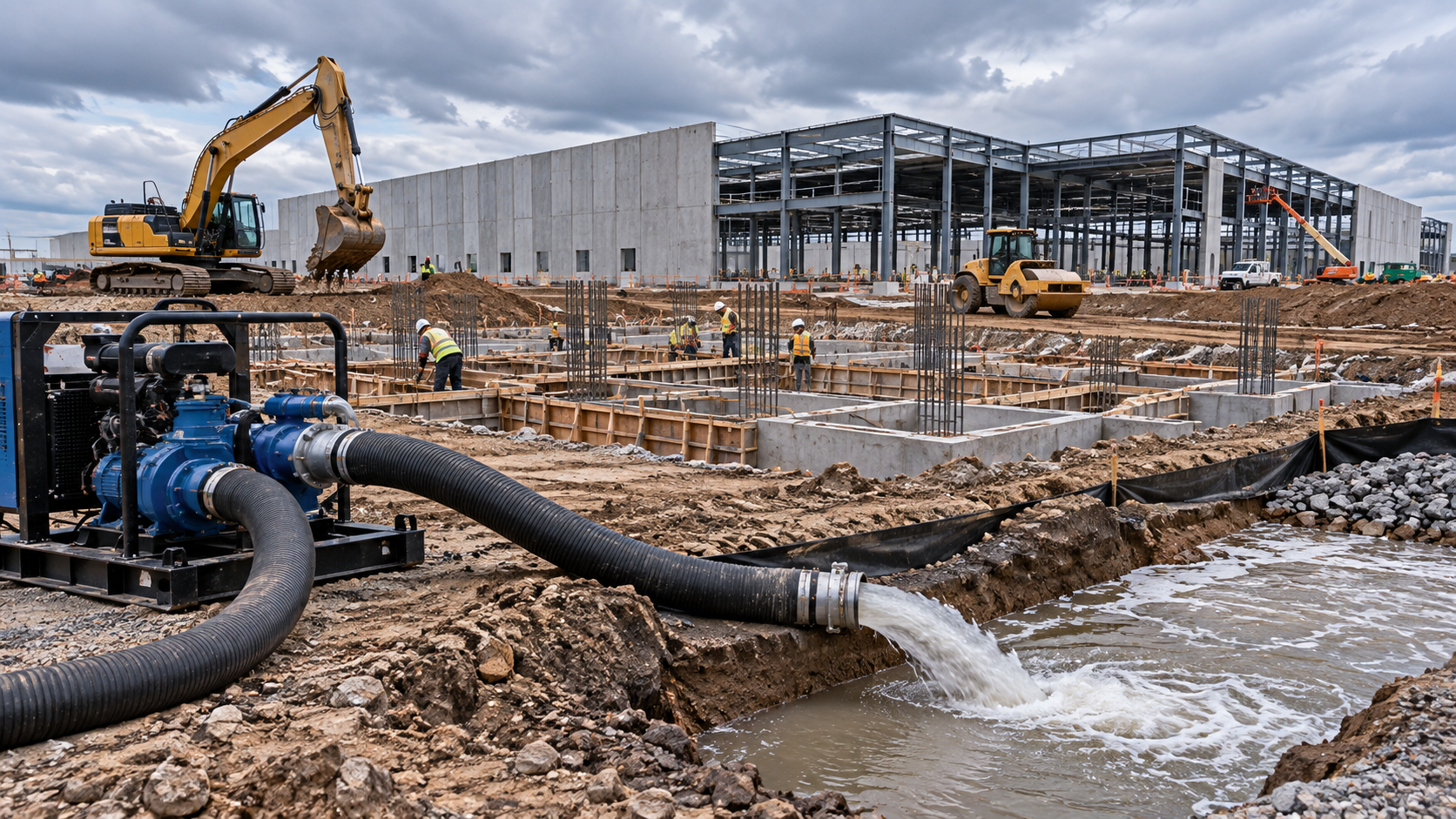
Data center site construction requires suction hose and discharge hose for dewatering, cam and groove fittings to connect them fast, and rigging equipment for structural steel and heavy equipment placement. PVC handles most light-duty dewatering; rubber suction and discharge hose is specified for heavier pump applications. Cam groove couplings — aluminum for most site work, stainless for corrosive environments — connect and disconnect without tools. ARG Industrial stocks all three categories for data center construction projects nationwide.
What Happens During Data Center Site Construction
Before a data center site construction project breaks ground, the supply chain for civil work is already running behind. Excavation, grading, foundation forming, and structural steel erection all happen in compressed timeframes — and every phase has hose and fitting requirements that need to be on site before the equipment arrives, not after.
Three product categories cover the majority of what a data center site construction job needs from day one: suction and discharge hose for dewatering and water management, cam and groove fittings to connect them without downtime, and rigging hardware for structural steel placement and heavy equipment operations. Getting these right before the excavator shows up is the difference between a smooth site and one that's chasing supply.
Suction Hose and Discharge Hose for Site Dewatering
Excavation for a data center foundation moves a significant volume of earth — and in most climates, it moves water too. Groundwater intrusion, stormwater, and concrete washout all require active management from the first day of excavation through foundation completion. Dewatering pumps run continuously on active sites, and the hose running to and from them is consumable — it gets cut, kinked, driven over, and UV-degraded over the course of a project.
Discharge Hose
Discharge hose moves water away from the pump outlet to a settling area, drainage channel, or discharge point. PVC discharge hose is the standard for most construction site dewatering — lightweight, flexible, and easy to move as the site evolves. Lay-flat discharge hose is common for long runs where the hose needs to travel across active work areas without creating a trip or equipment hazard.
Rubber water discharge hose handles higher temperatures, heavier abrasion, and rougher site conditions than PVC. For pump applications with hot water discharge, chemical contact, or heavy equipment running over the hose, rubber is the correct call. Continental Prospector suction and discharge hose is the standard spec for medium-to-heavy duty site applications — rated to 150 psi with a nitrile tube for broad fluid compatibility.
Suction Hose
Water suction hose is built differently from discharge hose — it has to resist vacuum without collapsing, which requires a rigid internal helix. PVC suction hose with a wire or PVC helix is the standard for trash pump and submersible pump applications on construction sites. Kuriyama Tigerflex Blue Water suction hose is a common specification — phthalate-free, rated to 115 psi, and built to remain flexible in cold-climate conditions down to -40°F, which matters on northern tier and mountain site jobs.
Water suction hoses are sized to match the pump inlet — match the hose ID to the pump port size and confirm the cam and groove fitting at the connection point is the same diameter. Mismatched sizes at the pump connection are the most common source of lost prime on a dewatering setup.
Cam and Groove Fittings for Site Water Management
A two-part quick-disconnect coupling consisting of a male adapter and a female coupler that lock together using cam arms — no tools required. The cam arms press the adapter into the coupler gasket, creating a seal. Standard sizes run 1/2" to 6" for construction site use. Manufactured to A-A-59326 (formerly MIL-C-27487), ensuring interchangeability across manufacturers when the same type and size are used.
Cam and groove fittings are the standard connection method for suction and discharge hose on construction sites because they connect and disconnect in seconds without tools. On an active dewatering setup, the pump moves regularly as the excavation progresses — cam groove couplings let a crew disconnect the hose, relocate the pump, and reconnect without wrenches or downtime.
Type Selection
Cam and groove fittings come in seven standardized types (A through F, plus DC) that define which end connects to what. The most common on construction sites are Type C (female coupler x hose stem — connects to the hose), Type A (male adapter x male NPT — connects to a threaded pump port), and Type E (female coupler x female NPT). Mixing types from the same series and size is fine — mixing sizes is not. A 2" Type C coupler on a 3" hose will leak at the connection and potentially blow off under pressure.
Material Selection
Aluminum cam groove couplings are the standard for water and most construction site fluids — lightweight, corrosion-resistant to water and mild chemicals, and less expensive than stainless. Stainless steel is specified when the fluid is corrosive, when the fitting will be exposed to saltwater or aggressive chemicals, or when the project specification requires it. Polypropylene is an option for light-duty chemical applications but is not appropriate for heavy-duty or high-cycle construction use.
Rigging for Construction - Site Steel and Heavy Equipment
Data center site construction involves heavy structural steel placement and the operation of large equipment in constrained site conditions. Rigging for construction at this phase is distinct from the mechanical equipment rigging that happens later during cooling system installation — it covers structural steel erection, precast concrete panel placement, and the day-to-day material handling that runs throughout the civil phase.
Heavy equipment rigging and installation on a data center site typically includes shackles and slings for steel erection, chain hoists for precision placement, and wire rope for material handling around the site. The same OSHA 1926.251 requirements that govern mechanical equipment lifts apply here — WLL marked and legible, pre-use inspection every shift, and rigging hardware matched to the load.
For rigging for construction that involves frequent connection and disconnection — hoisting rebar bundles, setting forms, moving precast panels — alloy chain slings and hook-and-shackle assemblies see high cycle counts. Inspect more frequently when cycle counts are high and replace at the first sign of wear, deformation, or illegible WLL markings. Browse ARG Industrial's full rigging and lifting products category for chain slings, wire rope, shackles, and hooks for site construction applications.
Before Ground Break - Supply Checklist
Site construction supply is most often needed the day the excavator arrives — not the week after. Work through these before the first machine hits the site.
The full ARG Industrial data center supply category covers site construction through commissioning and operations — hose, fittings, and rigging for every phase of the build.
Frequently Asked Questions
Most trash pumps and submersible pumps have male NPT threaded ports. A Type A cam and groove adapter (male adapter x male NPT) threads into a female-threaded pump port. A Type B (male adapter x female NPT) threads onto a male-threaded pump port. Confirm the pump port thread type and gender before ordering — incorrect type selection is the most common fitting ordering error on job sites.
PVC water suction hose is lighter, less expensive, and handles standard dewatering applications well. Rubber suction hose handles higher temperatures, heavier abrasion, and more aggressive site conditions. For most construction site dewatering, PVC performs fine. Specify rubber when the discharge is heated, when the hose runs through high-traffic areas where equipment might contact it, or when the project specification requires it.
Yes — cam and groove fittings are standardized to A-A-59326, which replaced the original MIL-C-27487 military specification. A Dixon Type C coupler and a PT Coupling Type C adapter in the same size will connect and seal correctly. The type (A through F) and the nominal size must match. Mixing types or mixing sizes from different manufacturers will result in a fitting that either won't connect or won't hold pressure.
2" and 3" discharge hose covers most construction site dewatering pump applications. 2" works for smaller submersible pumps handling groundwater in foundation excavations. 3" is common for larger trash pumps managing higher volumes during active excavation or stormwater events. Match hose size to the pump's discharge port size — running a hose smaller than the pump outlet restricts flow and reduces pumping efficiency.
ARG Industrial stocks cam and groove fittings in aluminum, stainless, and polypropylene, alongside PVC and rubber suction and discharge hose — available at branch locations or shipped direct to the job site. We carry PT Coupling, Dixon, and Kuriyama product lines across a full range of sizes for construction site applications.